
COLOURS IN THE QURAN AND THEIR SYMBOLISM: A COMPREHENSIVE THEOLOGICAL, LINGUISTIC, AND DISABILITY STUDIES ANALYSIS
Abstract
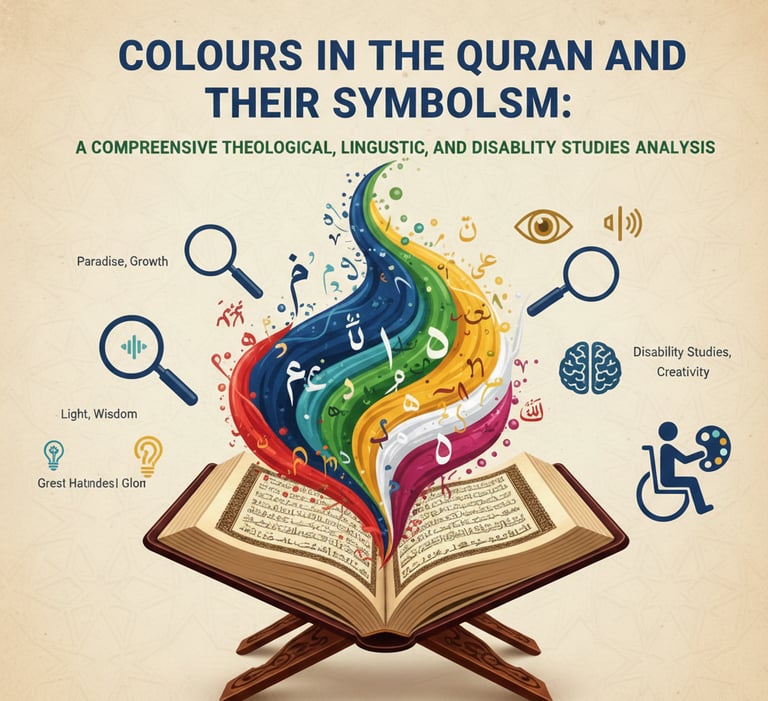
This research manuscript provides an exhaustive examination of colour terminology in the Quran, exploring their linguistic roots, contextual usage, profound symbolic meanings, and cross-cultural resonances within Islamic theology through the lens of disability studies. Through systematic analysis of the Arabic text, this study identifies and interprets the primary colours mentioned in the Quranic corpus—green, white, black, red, yellow, and blue—along with their various shades, composite forms, and metaphorical applications across approximately seventy verses. The research demonstrates that colours in the Quran function not merely as descriptive elements but as complex semiotic systems conveying theological truths, eschatological realities, spiritual states, divine attributes, and ethical imperatives. Critically, this study examines how Quranic colour theology operates as an inclusive framework that transcends visual privilege, offering multi-sensory pathways to spiritual knowledge for persons with visual, cognitive, and sensory disabilities. By analyzing chromatic references through phenomenological and accessibility-centered frameworks, this research reveals how the Quran's sensory epistemology accommodates diverse embodiments, challenging ableist assumptions that privilege sighted experience in religious meaning-making. The findings indicate that Quranic colour symbolism reflects both the natural world as perceived by seventh-century Arabs and transcendent realities beyond sensory experience, creating a sophisticated interplay between material and spiritual dimensions that remains accessible across sensory abilities. This manuscript contributes to Quranic studies, Islamic aesthetics, religious semiotics, comparative theology, and disability theology, offering insights relevant for contemporary theological reflection, artistic expression, interfaith engagement, and inclusive religious practice.